
Ball V - Red Boss Challenge
MGIFAdventure
4.4175.00 Reviews
- Version
- 1.7.8
- Installs
- 10.00M
- Age Rating
- Everyone
Screenshots
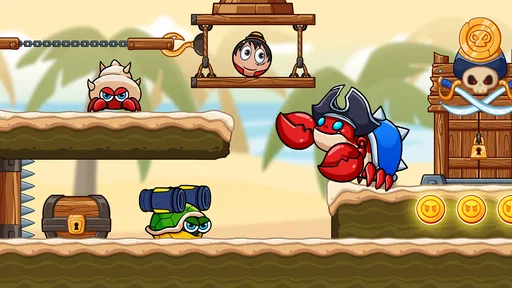
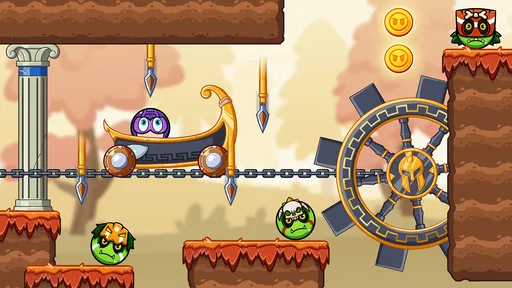


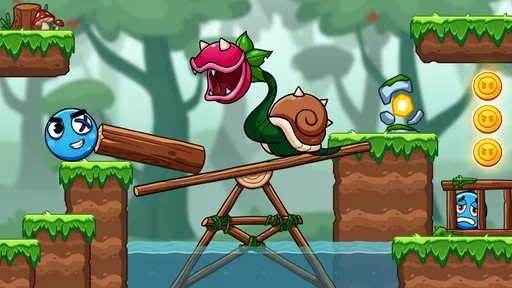
Our Review of Ball V - Red Boss Challenge
 Analysis by Appyee
I spent time with Ball V - Red Boss Challenge as a quick, obstacle-focused adventure game, and its central appeal became clear almost immediately: the rolling ball is not just a character to move from one point to another, but the main tool for solving each dangerous stretch. The experience is built around momentum, timing, and the simple satisfaction of getting through a difficult section without losing control.
That focus makes it easy to understand, but not always easy to master. I could start playing without a long explanation, yet later attempts demanded more attention than the bright, approachable presentation first suggested. If you enjoy games where a small movement mistake can turn a promising run into a restart, this one has a useful balance of accessibility and challenge. If you prefer relaxed exploration with little pressure, the repeated precision may become tiring.
Why the rolling-ball challenge matters
The game comes from MGIF and sits in the adventure category, although I would describe it more specifically as a compact rolling ball platformer. The world-saving setup gives the action a clear purpose, but the real reason to continue is practical: each section asks me to control speed, direction, and timing well enough to keep moving while dealing with hazards and rescuing friends.
That single capability shapes nearly every moment. In a conventional platform game, I usually think about jumping from one fixed surface to another. Here, I am also thinking about how the ball’s movement will carry into the next moment. A turn taken too quickly can create a problem several seconds later, while a cautious approach can make a difficult passage manageable. The challenge is less about memorizing a complicated control scheme and more about reading the space before committing.
I found that design especially effective during short sessions. I could play for a few minutes, fail, understand the reason, and try again without feeling that I had lost a large amount of progress. That retry-friendly rhythm suits a phone well. It also means the game can become surprisingly absorbing: a stage that initially feels awkward often becomes the one I want to repeat until my movements are cleaner.
The store page presents it as a free game for everyone, and that description matches the approachable starting point. The age rating is Everyone, so it is an easy recommendation for households looking for a light action game rather than something built around mature themes. Still, accessible presentation should not be confused with effortless play. The later challenge comes from control and timing, not from complicated rules.
What I learned from controlling the ball
My first useful adjustment was to stop treating every movement as an emergency. The instinct is to react immediately whenever the ball approaches a hazard, but quick reactions are not always good reactions. I had better results when I watched the shape of the route, identified where the ball needed to be after the next turn, and then made a smaller correction instead of a dramatic one.
This is one of the game’s less obvious strengths. It encourages planning without presenting itself as a traditional puzzle game. The route may look like an action sequence, but successful play often comes from making decisions early. When I waited until the last possible moment, I regularly overcorrected. When I prepared for the turn before it arrived, the same section felt much more controlled.
A second tip is to separate learning attempts from completion attempts. On an early run, I deliberately treated unfamiliar areas as experiments. I paid attention to where my movement became unstable and which approach left the ball in a useful position. On the next attempt, I could focus on execution rather than trying to discover and perform the route simultaneously. That small change reduced frustration more than simply playing faster.
The game also rewards accepting that a safe route may be better than the most direct route. When I tried to rush toward the apparent objective, I sometimes entered the next section with too much momentum. A slightly slower line gave me more room to react and made the following obstacle easier. This trade-off is important because the best-looking path is not always the best-playing path.
How it feels in an everyday play session
My favorite use case is a short break when I want something more engaging than an idle game but less demanding than a long role-playing adventure. I can open it, attempt a handful of sections, and put it down after a natural stopping point. The controls and objective are direct enough that I do not need to spend the first part of the session remembering a large inventory, a complicated map, or a long story.
Imagine waiting for a train or taking a quiet break between tasks. A quick attempt can be satisfying even if it ends in failure, because the failure usually tells me something about my timing. I might realize that I approached a turn too quickly, reacted too late, or chose a poor line. That makes the next attempt feel purposeful rather than random.
It is also suitable for someone who likes sharing a simple challenge with a younger player. The basic idea is easy to explain: guide the ball, avoid trouble, and help complete the adventure. I would still expect an adult or experienced player to assist if a section becomes frustrating, because the Everyone rating describes the content, not a guarantee that every challenge will be easy for every age.
For a longer session, the experience depends heavily on how much I enjoy repetition. I liked replaying a difficult stretch when I could see a clear mistake to correct. I was less enthusiastic when several attempts failed for nearly the same reason without giving me a strong sense of progress. That distinction matters: this is a game for improving control, not a passive way to fill time.
Practical ways to make difficult sections less frustrating
I recommend using the first attempt in a new area to establish a rhythm rather than chase speed. Watch how much space is available before changing direction, and try to enter the next section in a stable position. A controlled entrance often matters more than a fast exit from the previous obstacle.
When a run fails, I found it useful to name the exact mistake before restarting. “I was too fast into the turn” is actionable; “the level is unfair” is not. Sometimes the problem was not the obstacle itself but the position I carried into it. This habit turned retries into small lessons and helped me distinguish a genuine control issue from simple impatience.
Another practical approach is to avoid making several corrections at once. If I changed direction repeatedly in a panic, the ball became harder to predict. A single deliberate adjustment followed by a moment of observation gave me more information. That is particularly helpful for players who normally rely on rapid tapping in mobile action games and may initially overplay the controls here.
I would also suggest playing with a clear stopping rule. Because the stages invite “one more try,” frustration can build unnoticed. After several unsuccessful attempts, taking a short break often helped me return with better timing. The game is simple enough to resume quickly, so there is little benefit in forcing a tired session.
Where the free model fits into the experience
The game is free to start, with in-app purchases ranging from $0.99 to $2.99 per item. That makes the initial decision straightforward: anyone interested in the rolling challenge can try it without paying upfront. I appreciate that model for a game whose appeal depends on whether its movement feels satisfying to the individual player.
At the same time, I would approach optional spending carefully. A purchase can make sense if it removes a specific annoyance for someone who already enjoys the game, but it should not be treated as a substitute for learning the movement. The core skill is still timing and control. If the basic handling does not feel enjoyable, spending more is unlikely to change that fundamental reaction.
Because the price structure is item-based rather than a single paid download, the game is better suited to readers who are comfortable deciding for themselves whether optional extras are worthwhile. Families may want to discuss purchases before handing the device to a child. The Everyone rating makes the content approachable, but it does not remove the need for sensible spending boundaries.
The main trade-off: simplicity against variety
The strongest part of the game is also the source of its biggest limitation. Keeping the ball at the center gives the experience a clear identity, but it means players who want a broad collection of mechanics may eventually find the formula narrow. I did not come to this title for deep character development, complex equipment, or a large strategic system. I came for movement, obstacles, and the satisfaction of improving a run.
Compared with a traditional adventure game, this is much lighter on exploration and long-form discovery. Compared with an endless runner, it feels more deliberate because I am trying to understand a route rather than simply survive for as long as possible. Compared with a physics puzzle game, it places more emphasis on active control and immediate reactions than on arranging objects or solving a static problem.
That comparison helps clarify who should choose it. If you want a colorful, direct challenge that can be learned in moments and refined over repeated attempts, the focused design is a benefit. If you want an expansive adventure with a large world, many character abilities, or a story that carries the experience between challenges, a different game will probably serve you better.
I also noticed that the same section can feel very different depending on my mood. When I was patient, the ball’s movement felt like a problem I could gradually solve. When I was distracted, small errors multiplied quickly. That makes the game a poor choice for someone who wants completely passive entertainment, but a good choice for a player who enjoys giving a short session full attention.
Who benefits most from this particular design
The best match is a player who likes compact challenges, visible improvement, and controls that are easy to understand but require practice. It works especially well for people who enjoy repeating a stage to improve their route rather than moving on after a single completion. The adventure framing adds motivation, while the rolling mechanic keeps the focus on what the player is doing now.
It is also a sensible pick for newcomers to mobile action games. There is no need to learn a large set of buttons before discovering whether the game is enjoyable. The first sessions communicate the basic idea quickly, and the challenge grows through execution. Someone introducing a child or casual player to platform-style games may find that approachable structure useful.
On the other hand, I would skip it if my priority were a calm game with no meaningful penalty for mistakes. I would also look elsewhere if I wanted a deep narrative, extensive customization, or a broad selection of unrelated activities. The title earns its place by doing one thing clearly, not by trying to cover every kind of adventure.
Device compatibility is reasonably broad for an older Android phone or tablet, since it supports Android 7.0 and later. That does not tell me how every individual device will perform, but it does make the game accessible to people who are not using the newest hardware. The current version is 1.7.8, so I would install the available release rather than rely on an old copy when troubleshooting.
My final take after learning its rhythm
After spending time with it, I see the game as a focused test of movement rather than a full-scale adventure replacement. The rescue-and-save-the-world framing gives the rolling journey a reason, but the lasting appeal comes from handling the ball more intelligently with each attempt. Its most satisfying moments arrive when a section that once felt chaotic becomes predictable because I changed my approach.
Its popularity is easy to understand: it has a 4.4 average from around 29 thousand ratings and has passed 10 million installs. Those figures do not guarantee that every player will enjoy the same level of challenge, but they fit my impression of a game with a very clear hook and a broad starting appeal.
I recommend Ball V - Red Boss Challenge to anyone who wants a free adventure game for short, active sessions and enjoys learning through retries. My advice is to play patiently, treat early failures as route information, and avoid rushing simply because the objective looks close. The game is at its best when I give its central mechanic room to work.
For me, the final decision is simple: try it if careful rolling, timing, and gradual improvement sound rewarding. Skip it if you need constant novelty or a story-heavy experience. The developer, MGIF, has built the game around a narrow idea, but that idea is clear enough to make the title memorable when the challenge matches your taste.
Verdict
Strengths of Ball V - Red Boss Challenge
- Simple controls make the game easy to pick up quickly.
- Short levels are convenient for quick gaming sessions.
- Boss encounters add variety beyond standard obstacle courses.
- Bright visuals make hazards and platforms easy to recognize.
- Offline play is useful when you have no internet connection.
Limitations of Ball V - Red Boss Challenge
- Repeated attempts can feel frustrating when progress depends on precise timing.
- The gameplay may become repetitive after extended sessions.
- Some levels offer limited room for experimentation or alternate routes.
- Touch controls can feel less responsive during fast movements.
- Advertising may interrupt play or appear frequently between attempts.
Similar Picks in This Category
View All
Roblox
Roblox Corporation4.2

Pokémon GO
Niantic, Inc.3.5

Ninja warrior: legend of adven
TOH Games4.6

Ninja Arashi
Black Panther4.6

Eyes - The Horror Game
Fearless Games sp. j.4.5

Critical Action:Gun Strike Ops
FPS Shooter & Action Game4.3
Frequently Asked Questions
What is Ball V - Red Boss Challenge?
Ball V - Red Boss Challenge is a fast-paced arcade platform game centered on guiding a bouncing red ball through hazardous stages. Players must avoid traps, overcome moving obstacles, collect useful items, and reach the end of each level safely. Its simple controls make it easy to start, while increasingly difficult layouts and boss-style challenges demand careful timing and patience.
How do you play Ball V - Red Boss Challenge?
Gameplay focuses on controlling the ball’s movement and timing jumps or directional changes accurately. You generally need to move across platforms, avoid spikes and other dangers, and react quickly to changing obstacles. Before downloading, keep in mind that the controls are straightforward but the later stages can be demanding, so success depends more on practice, precision, and learning each level than on complicated button combinations.
Is Ball V - Red Boss Challenge suitable for children?
The game is generally appropriate for players who enjoy cartoon-style arcade challenges, including older children and teenagers. However, its difficulty may lead to frustration for younger players, especially when repeating sections after a mistake. Parents should also review the store listing for the current age rating, advertising policy, in-app purchase information, and privacy details, since these elements can vary between Android and iOS versions.
Does Ball V - Red Boss Challenge require an internet connection?
The core platform gameplay may be playable offline, which makes the title convenient for short sessions while traveling or when a stable connection is unavailable. Nevertheless, some features—such as advertisements, analytics, updates, leaderboards, or promotional content—may require internet access. It is best to check the app’s current store description and test the game after installation if offline play is important to you.
Is Ball V - Red Boss Challenge free to download?
Ball V - Red Boss Challenge may be offered as a free download, but availability of advertisements, optional purchases, or other monetization features can depend on the version and platform. Users should check the Google Play or App Store listing before installing to confirm the exact pricing, permissions, supported devices, and purchase details. Also make sure your device has enough storage and runs a compatible operating-system version.
Play our best games!


